


Number: 2658
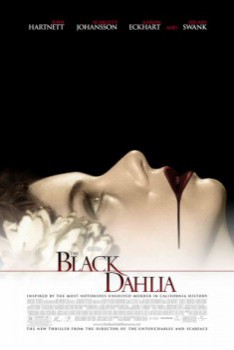


Country: Germany, 121 minutes
Spoken Languages: English, German
Genre(s): Thriller, Drama, Crime, Mystery
Director(s): Brian De Palma
Video Codec: Unknown
Storyline:
In 1946, the former boxers Dwight "Bucky" Bleichert and Lee Blanchard are policemen in Los Angeles. Lee has a good relationship with his chief and uses a box fight between them to promote the department and get a raise to the police force. They succeed and are promoted to homicide detectives, working together. Bucky becomes a close friend of Lee and his girlfriend Kay Lake, forming a triangle of love. When the corpse of the aspirant actress 'Elizabeth Short (I)' is found mutilated, Lee becomes obsessed to solve the case called by the press Black Dahlia. Meanwhile, Bucky's investigation leads him to a Madeleine Linscott, the daughter of a powerful and wealthy constructor that resembles the Black Dahlia. In an environment of corruption and lies, Bucky discloses hidden truths.
Tagline:
Cast:
 Josh Hartnett
"For murder, though it have no tongue, will speak/With most miraculous organ." Shakespeare's Hamlet Murders are messy on the screen and in real life; screenplays about them can be chaotic and disjointed also. Such is the case with Black Dahlia, a film noir from Brian De Palma, a past master of the macabre and the complicated (Blow Out, Body Double). It has all the trappings of a first-rate detective novel (James Ellroy) made into a 1940's thriller with appropriately moody music of the soulful trumpet (Mark Isham), lush production design (Dante Ferretti), and equally impressive costuming (Jenny Beavan), all set in a timelessly seedy Los Angeles. There's also the conflicted, sometimes dark hero detective (Josh Hartnett) and the sexy, dangerous femme fatale (Hilary Swank), accompanied by the questionably good voluptuary sex bomb (Scarlett Johansson). As if these noir troublemakers were not enough, writer Josh Friedman seemingly adapts Ellroy's every subplot, every story thread, as if each had to be accounted for in the best CSI tradition. The original novel was based on aspiring actress Elizabeth Short's unsolved grizzly murder in 1947. After a considerably convoluted exposition, with plot lines rarely intersecting in a unified way, the film has the nerve to offer one of the most extensive denouements in film history, could be a half hour, with lengthy explanation of how all those ends tied together. Needless to say, anti climaxes abound in this last segment, leaving not only more confusion about the plot but also a desire to get back to The Big Sleep without sleeping, a state Black Dahlia threatened several times. Hartnett's detective says, "Nothing stays buried forever. Nothing." I say this weak noir wannabe should stay buried until a bright 22nd century scholar sees its cultural and aesthetic significance. Until then, it's a jumble of plot points resolved in the end by tedious narration. Even Scarlett Johansson's pulchritude couldn't win me, and that's murder in the first degree.
Josh Hartnett
"For murder, though it have no tongue, will speak/With most miraculous organ." Shakespeare's Hamlet Murders are messy on the screen and in real life; screenplays about them can be chaotic and disjointed also. Such is the case with Black Dahlia, a film noir from Brian De Palma, a past master of the macabre and the complicated (Blow Out, Body Double). It has all the trappings of a first-rate detective novel (James Ellroy) made into a 1940's thriller with appropriately moody music of the soulful trumpet (Mark Isham), lush production design (Dante Ferretti), and equally impressive costuming (Jenny Beavan), all set in a timelessly seedy Los Angeles. There's also the conflicted, sometimes dark hero detective (Josh Hartnett) and the sexy, dangerous femme fatale (Hilary Swank), accompanied by the questionably good voluptuary sex bomb (Scarlett Johansson). As if these noir troublemakers were not enough, writer Josh Friedman seemingly adapts Ellroy's every subplot, every story thread, as if each had to be accounted for in the best CSI tradition. The original novel was based on aspiring actress Elizabeth Short's unsolved grizzly murder in 1947. After a considerably convoluted exposition, with plot lines rarely intersecting in a unified way, the film has the nerve to offer one of the most extensive denouements in film history, could be a half hour, with lengthy explanation of how all those ends tied together. Needless to say, anti climaxes abound in this last segment, leaving not only more confusion about the plot but also a desire to get back to The Big Sleep without sleeping, a state Black Dahlia threatened several times. Hartnett's detective says, "Nothing stays buried forever. Nothing." I say this weak noir wannabe should stay buried until a bright 22nd century scholar sees its cultural and aesthetic significance. Until then, it's a jumble of plot points resolved in the end by tedious narration. Even Scarlett Johansson's pulchritude couldn't win me, and that's murder in the first degree.
 Scarlett Johansson
"For murder, though it have no tongue, will speak/With most miraculous organ." Shakespeare's Hamlet Murders are messy on the screen and in real life; screenplays about them can be chaotic and disjointed also. Such is the case with Black Dahlia, a film noir from Brian De Palma, a past master of the macabre and the complicated (Blow Out, Body Double). It has all the trappings of a first-rate detective novel (James Ellroy) made into a 1940's thriller with appropriately moody music of the soulful trumpet (Mark Isham), lush production design (Dante Ferretti), and equally impressive costuming (Jenny Beavan), all set in a timelessly seedy Los Angeles. There's also the conflicted, sometimes dark hero detective (Josh Hartnett) and the sexy, dangerous femme fatale (Hilary Swank), accompanied by the questionably good voluptuary sex bomb (Scarlett Johansson). As if these noir troublemakers were not enough, writer Josh Friedman seemingly adapts Ellroy's every subplot, every story thread, as if each had to be accounted for in the best CSI tradition. The original novel was based on aspiring actress Elizabeth Short's unsolved grizzly murder in 1947. After a considerably convoluted exposition, with plot lines rarely intersecting in a unified way, the film has the nerve to offer one of the most extensive denouements in film history, could be a half hour, with lengthy explanation of how all those ends tied together. Needless to say, anti climaxes abound in this last segment, leaving not only more confusion about the plot but also a desire to get back to The Big Sleep without sleeping, a state Black Dahlia threatened several times. Hartnett's detective says, "Nothing stays buried forever. Nothing." I say this weak noir wannabe should stay buried until a bright 22nd century scholar sees its cultural and aesthetic significance. Until then, it's a jumble of plot points resolved in the end by tedious narration. Even Scarlett Johansson's pulchritude couldn't win me, and that's murder in the first degree.
Scarlett Johansson
"For murder, though it have no tongue, will speak/With most miraculous organ." Shakespeare's Hamlet Murders are messy on the screen and in real life; screenplays about them can be chaotic and disjointed also. Such is the case with Black Dahlia, a film noir from Brian De Palma, a past master of the macabre and the complicated (Blow Out, Body Double). It has all the trappings of a first-rate detective novel (James Ellroy) made into a 1940's thriller with appropriately moody music of the soulful trumpet (Mark Isham), lush production design (Dante Ferretti), and equally impressive costuming (Jenny Beavan), all set in a timelessly seedy Los Angeles. There's also the conflicted, sometimes dark hero detective (Josh Hartnett) and the sexy, dangerous femme fatale (Hilary Swank), accompanied by the questionably good voluptuary sex bomb (Scarlett Johansson). As if these noir troublemakers were not enough, writer Josh Friedman seemingly adapts Ellroy's every subplot, every story thread, as if each had to be accounted for in the best CSI tradition. The original novel was based on aspiring actress Elizabeth Short's unsolved grizzly murder in 1947. After a considerably convoluted exposition, with plot lines rarely intersecting in a unified way, the film has the nerve to offer one of the most extensive denouements in film history, could be a half hour, with lengthy explanation of how all those ends tied together. Needless to say, anti climaxes abound in this last segment, leaving not only more confusion about the plot but also a desire to get back to The Big Sleep without sleeping, a state Black Dahlia threatened several times. Hartnett's detective says, "Nothing stays buried forever. Nothing." I say this weak noir wannabe should stay buried until a bright 22nd century scholar sees its cultural and aesthetic significance. Until then, it's a jumble of plot points resolved in the end by tedious narration. Even Scarlett Johansson's pulchritude couldn't win me, and that's murder in the first degree.
 Aaron Eckhart
"For murder, though it have no tongue, will speak/With most miraculous organ." Shakespeare's Hamlet Murders are messy on the screen and in real life; screenplays about them can be chaotic and disjointed also. Such is the case with Black Dahlia, a film noir from Brian De Palma, a past master of the macabre and the complicated (Blow Out, Body Double). It has all the trappings of a first-rate detective novel (James Ellroy) made into a 1940's thriller with appropriately moody music of the soulful trumpet (Mark Isham), lush production design (Dante Ferretti), and equally impressive costuming (Jenny Beavan), all set in a timelessly seedy Los Angeles. There's also the conflicted, sometimes dark hero detective (Josh Hartnett) and the sexy, dangerous femme fatale (Hilary Swank), accompanied by the questionably good voluptuary sex bomb (Scarlett Johansson). As if these noir troublemakers were not enough, writer Josh Friedman seemingly adapts Ellroy's every subplot, every story thread, as if each had to be accounted for in the best CSI tradition. The original novel was based on aspiring actress Elizabeth Short's unsolved grizzly murder in 1947. After a considerably convoluted exposition, with plot lines rarely intersecting in a unified way, the film has the nerve to offer one of the most extensive denouements in film history, could be a half hour, with lengthy explanation of how all those ends tied together. Needless to say, anti climaxes abound in this last segment, leaving not only more confusion about the plot but also a desire to get back to The Big Sleep without sleeping, a state Black Dahlia threatened several times. Hartnett's detective says, "Nothing stays buried forever. Nothing." I say this weak noir wannabe should stay buried until a bright 22nd century scholar sees its cultural and aesthetic significance. Until then, it's a jumble of plot points resolved in the end by tedious narration. Even Scarlett Johansson's pulchritude couldn't win me, and that's murder in the first degree.
Aaron Eckhart
"For murder, though it have no tongue, will speak/With most miraculous organ." Shakespeare's Hamlet Murders are messy on the screen and in real life; screenplays about them can be chaotic and disjointed also. Such is the case with Black Dahlia, a film noir from Brian De Palma, a past master of the macabre and the complicated (Blow Out, Body Double). It has all the trappings of a first-rate detective novel (James Ellroy) made into a 1940's thriller with appropriately moody music of the soulful trumpet (Mark Isham), lush production design (Dante Ferretti), and equally impressive costuming (Jenny Beavan), all set in a timelessly seedy Los Angeles. There's also the conflicted, sometimes dark hero detective (Josh Hartnett) and the sexy, dangerous femme fatale (Hilary Swank), accompanied by the questionably good voluptuary sex bomb (Scarlett Johansson). As if these noir troublemakers were not enough, writer Josh Friedman seemingly adapts Ellroy's every subplot, every story thread, as if each had to be accounted for in the best CSI tradition. The original novel was based on aspiring actress Elizabeth Short's unsolved grizzly murder in 1947. After a considerably convoluted exposition, with plot lines rarely intersecting in a unified way, the film has the nerve to offer one of the most extensive denouements in film history, could be a half hour, with lengthy explanation of how all those ends tied together. Needless to say, anti climaxes abound in this last segment, leaving not only more confusion about the plot but also a desire to get back to The Big Sleep without sleeping, a state Black Dahlia threatened several times. Hartnett's detective says, "Nothing stays buried forever. Nothing." I say this weak noir wannabe should stay buried until a bright 22nd century scholar sees its cultural and aesthetic significance. Until then, it's a jumble of plot points resolved in the end by tedious narration. Even Scarlett Johansson's pulchritude couldn't win me, and that's murder in the first degree.
 Hilary Swank
"For murder, though it have no tongue, will speak/With most miraculous organ." Shakespeare's Hamlet Murders are messy on the screen and in real life; screenplays about them can be chaotic and disjointed also. Such is the case with Black Dahlia, a film noir from Brian De Palma, a past master of the macabre and the complicated (Blow Out, Body Double). It has all the trappings of a first-rate detective novel (James Ellroy) made into a 1940's thriller with appropriately moody music of the soulful trumpet (Mark Isham), lush production design (Dante Ferretti), and equally impressive costuming (Jenny Beavan), all set in a timelessly seedy Los Angeles. There's also the conflicted, sometimes dark hero detective (Josh Hartnett) and the sexy, dangerous femme fatale (Hilary Swank), accompanied by the questionably good voluptuary sex bomb (Scarlett Johansson). As if these noir troublemakers were not enough, writer Josh Friedman seemingly adapts Ellroy's every subplot, every story thread, as if each had to be accounted for in the best CSI tradition. The original novel was based on aspiring actress Elizabeth Short's unsolved grizzly murder in 1947. After a considerably convoluted exposition, with plot lines rarely intersecting in a unified way, the film has the nerve to offer one of the most extensive denouements in film history, could be a half hour, with lengthy explanation of how all those ends tied together. Needless to say, anti climaxes abound in this last segment, leaving not only more confusion about the plot but also a desire to get back to The Big Sleep without sleeping, a state Black Dahlia threatened several times. Hartnett's detective says, "Nothing stays buried forever. Nothing." I say this weak noir wannabe should stay buried until a bright 22nd century scholar sees its cultural and aesthetic significance. Until then, it's a jumble of plot points resolved in the end by tedious narration. Even Scarlett Johansson's pulchritude couldn't win me, and that's murder in the first degree.
Hilary Swank
"For murder, though it have no tongue, will speak/With most miraculous organ." Shakespeare's Hamlet Murders are messy on the screen and in real life; screenplays about them can be chaotic and disjointed also. Such is the case with Black Dahlia, a film noir from Brian De Palma, a past master of the macabre and the complicated (Blow Out, Body Double). It has all the trappings of a first-rate detective novel (James Ellroy) made into a 1940's thriller with appropriately moody music of the soulful trumpet (Mark Isham), lush production design (Dante Ferretti), and equally impressive costuming (Jenny Beavan), all set in a timelessly seedy Los Angeles. There's also the conflicted, sometimes dark hero detective (Josh Hartnett) and the sexy, dangerous femme fatale (Hilary Swank), accompanied by the questionably good voluptuary sex bomb (Scarlett Johansson). As if these noir troublemakers were not enough, writer Josh Friedman seemingly adapts Ellroy's every subplot, every story thread, as if each had to be accounted for in the best CSI tradition. The original novel was based on aspiring actress Elizabeth Short's unsolved grizzly murder in 1947. After a considerably convoluted exposition, with plot lines rarely intersecting in a unified way, the film has the nerve to offer one of the most extensive denouements in film history, could be a half hour, with lengthy explanation of how all those ends tied together. Needless to say, anti climaxes abound in this last segment, leaving not only more confusion about the plot but also a desire to get back to The Big Sleep without sleeping, a state Black Dahlia threatened several times. Hartnett's detective says, "Nothing stays buried forever. Nothing." I say this weak noir wannabe should stay buried until a bright 22nd century scholar sees its cultural and aesthetic significance. Until then, it's a jumble of plot points resolved in the end by tedious narration. Even Scarlett Johansson's pulchritude couldn't win me, and that's murder in the first degree.
 Mia Kirshner
"For murder, though it have no tongue, will speak/With most miraculous organ." Shakespeare's Hamlet Murders are messy on the screen and in real life; screenplays about them can be chaotic and disjointed also. Such is the case with Black Dahlia, a film noir from Brian De Palma, a past master of the macabre and the complicated (Blow Out, Body Double). It has all the trappings of a first-rate detective novel (James Ellroy) made into a 1940's thriller with appropriately moody music of the soulful trumpet (Mark Isham), lush production design (Dante Ferretti), and equally impressive costuming (Jenny Beavan), all set in a timelessly seedy Los Angeles. There's also the conflicted, sometimes dark hero detective (Josh Hartnett) and the sexy, dangerous femme fatale (Hilary Swank), accompanied by the questionably good voluptuary sex bomb (Scarlett Johansson). As if these noir troublemakers were not enough, writer Josh Friedman seemingly adapts Ellroy's every subplot, every story thread, as if each had to be accounted for in the best CSI tradition. The original novel was based on aspiring actress Elizabeth Short's unsolved grizzly murder in 1947. After a considerably convoluted exposition, with plot lines rarely intersecting in a unified way, the film has the nerve to offer one of the most extensive denouements in film history, could be a half hour, with lengthy explanation of how all those ends tied together. Needless to say, anti climaxes abound in this last segment, leaving not only more confusion about the plot but also a desire to get back to The Big Sleep without sleeping, a state Black Dahlia threatened several times. Hartnett's detective says, "Nothing stays buried forever. Nothing." I say this weak noir wannabe should stay buried until a bright 22nd century scholar sees its cultural and aesthetic significance. Until then, it's a jumble of plot points resolved in the end by tedious narration. Even Scarlett Johansson's pulchritude couldn't win me, and that's murder in the first degree.
Mia Kirshner
"For murder, though it have no tongue, will speak/With most miraculous organ." Shakespeare's Hamlet Murders are messy on the screen and in real life; screenplays about them can be chaotic and disjointed also. Such is the case with Black Dahlia, a film noir from Brian De Palma, a past master of the macabre and the complicated (Blow Out, Body Double). It has all the trappings of a first-rate detective novel (James Ellroy) made into a 1940's thriller with appropriately moody music of the soulful trumpet (Mark Isham), lush production design (Dante Ferretti), and equally impressive costuming (Jenny Beavan), all set in a timelessly seedy Los Angeles. There's also the conflicted, sometimes dark hero detective (Josh Hartnett) and the sexy, dangerous femme fatale (Hilary Swank), accompanied by the questionably good voluptuary sex bomb (Scarlett Johansson). As if these noir troublemakers were not enough, writer Josh Friedman seemingly adapts Ellroy's every subplot, every story thread, as if each had to be accounted for in the best CSI tradition. The original novel was based on aspiring actress Elizabeth Short's unsolved grizzly murder in 1947. After a considerably convoluted exposition, with plot lines rarely intersecting in a unified way, the film has the nerve to offer one of the most extensive denouements in film history, could be a half hour, with lengthy explanation of how all those ends tied together. Needless to say, anti climaxes abound in this last segment, leaving not only more confusion about the plot but also a desire to get back to The Big Sleep without sleeping, a state Black Dahlia threatened several times. Hartnett's detective says, "Nothing stays buried forever. Nothing." I say this weak noir wannabe should stay buried until a bright 22nd century scholar sees its cultural and aesthetic significance. Until then, it's a jumble of plot points resolved in the end by tedious narration. Even Scarlett Johansson's pulchritude couldn't win me, and that's murder in the first degree.
Medium: Unknown,
Loaned: No
Aspect ratio: 2.35:1